
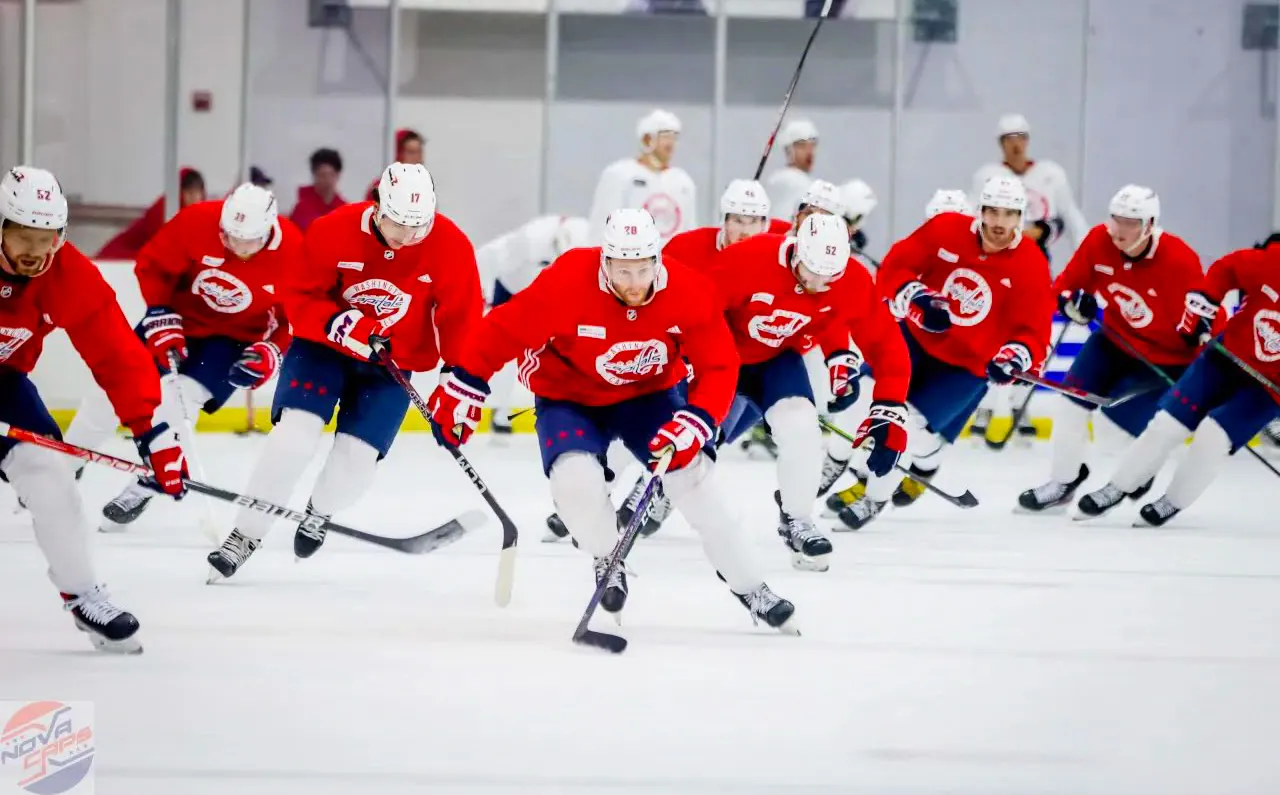
If you’ve been following along with our posts that outline the summer ahead for the Capitals and General Manager Brian MacLellan, you know that the Caps are intent on retooling the roster that failed to qualify for the playoffs for the first time since the 2013-14 season. The promise made to Alex Ovechkin when he signed his five-year contract extension in the summer of 2021 was to keep the team in contending form through his remaining years in Washington. That means that the Caps will be putting a true rebuild on the back burner.
That impending rebuild would make sense for a roster that has failed to break through the first round of the playoffs since their magical run for the Stanley Cup in the spring of 2018. The core group isn’t getting any younger. Aches and pains that could be played through in the past are harder to play through now.
Brian MacLellan stated in his end-of-season presser that his primary goal this off-season was to improve the Capitals top-six forwards. As a result, we’ll examine some of the paths forward for the Caps to acquire top six quality forwards that will ultimately improve the team.
Trades are the way
If you read our post that examined the top eight unrestricted free agents this summer, you would have seen that the UFA class is pretty weak on game-breaking prime-aged forwards that you’d be willing to overpay to sign. With only a meager $6,524,167 in cap space available in a $83.5M salary cap ceiling, there’s not a lot of space there to sign an impactful player when the open market drives costs up. That cap space also doesn’t include the next contract for Martin Fehervary, so there’s probably roughly $4.25M to work with at this point.
There’s another wrinkle in this plan, though. Other teams that are looking to improve their roster are going to know that the unrestricted free agent forward class this summer is a shallow pool. That means the trade market could be booming this summer. I’d expect a flurry of deals to happen the week of the NHL Entry Draft, as teams try to load up with the entire summer to work on salary cap compliance and the rest of their roster.
To pick, or not to pick
An intriguing idea is whether or not the Caps should decide to trade their eighth overall pick at the 2023 NHL Draft in June. The only way I foresee this as even a remote possibility is if the Caps are sitting at eight and the players left on the board either aren’t high on their draft board, or are years away from making the NHL club.
If the Caps were to look to deal the eighth overall selection, there’s probably only a handful of players that make the list, most notably being Alex DeBrincat, currently of the Ottawa Senators. There’s been some chatter that he might not want to sign a long-term deal with the Senators, and he’s a pending restricted free agent with only one more year of team control until he can hit the open market in unrestricted free agency.
Obviously, for the Caps to consider that trade, it’d have to be contingent on reaching an extension with DeBrincat. It’s intriguing, but I’d put my money on the Caps staying pat at #8 and selecting what will most likely be the top prospect this team has had since Karl Alzner was drafted fifth overall in the 2007 NHL Entry Draft.
Clearing the space
As mentioned before, the Caps only have a thin threshold of salary cap space left to make meaningful additions to the roster. With that, there’s been plenty of buzz around trading elite-when-he-wants-to-be Evgeny Kuznetsov and Anthony Mantha. Trading both would net the Caps $13.5M in cap space, which would be more than enough to add at least two high-calibre forwards to the mix.
The difficulty with trading either of these players is the value you get in return when you trade them. In my opinion, the Caps will never get actual commensurate value in a return if they traded Kuznetsov. The reason that’s the case is you can have nearly point-per-game Kuznetsov who creates offensively and can positively impact the result of the game, like we saw in the 2018 playoffs. On the other hand, Kuznetsov, when he’s not emotionally and mentally invested, can turn in performances like we saw this past season. Teams are only going to pay for the low end of the price tag for Kuznetsov and hope that the change of scenery sparks his dormant dominance.
Trading Kuznetsov would only really make sense if the Caps were receiving another top six center that’s in need of a change of scenery in return. Kuznetsov also has a ten-team no trade list that can really complicate finding a suitor and allows Kuznetsov to control a bit more of where his next destination will be.
For Anthony Mantha, the trade would be interesting. He only has a year left on his current contract, so dumping his salary wouldn’t be too costly for a team that needs to reach the salary cap floor. On the other hand, it might make more sense for the Caps to hold onto Mantha in hopes that the next coaching staff can reinvigorate his confidence and turn him back into the offensive force we saw in the first 10-15 games he played for the Caps after being acquired from the Detroit Red Wings.
It’s going to be a spectacle
This summer is going to be one of the more exciting off-seasons we’ve seen in a long time as fans of the Capitals. There’s going to be a lot of trade rumors and tweets from insiders that will cause a lot of buzz, either positive or negative.
Something to stew on: MacLellan has always been rather aggressive in addressing his team’s needs when he sees a weak point in the construction of the roster. Two examples really ring true here: adding both Darcy Kuemper and Charlie Lindgren last summer when he said he’d be addressing goaltending; and signing both Brooks Orpik and Matt Niskanen in free agency shortly after taking over as GM for George McPhee.
With that history in mind, I think we’ll see some aggressive pursuit of top six quality forwards in the trade market.
By Justin Trudel