
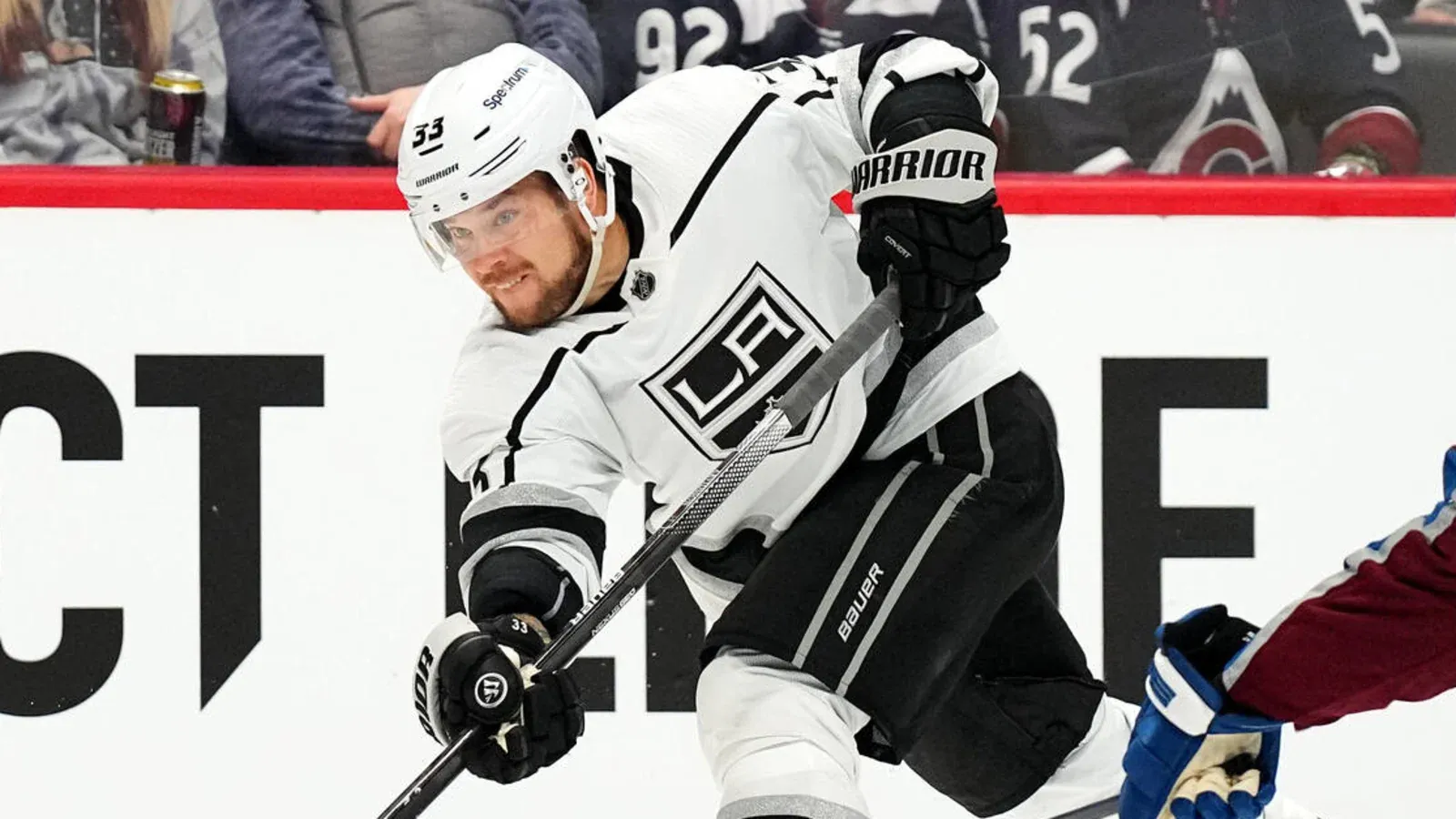
Photo: Ron Chenoy-USA TODAY Sports
Now that the NHL Playoffs have progressed to the Conference Finals, we’re starting to see a bit more chatter around the teams that have been eliminated and what folks can expect to see this summer with regards to potential player movement. One name that has surfaced in recent days is the possibility that Los Angeles Kings forward Viktor Arvidsson may be on the trade block.
Elliotte Friedman mentioned on the 32 Thoughts podcast (at the 45:30 mark) that the Kings want to re-sign Vladislav Gavrikov and acquire a goalie, and they’ll need to clear some cap space to make that happen. Would Arvidsson help the Caps? Let’s take a look.
The statistics and salary cap information used in this post are courtesy of Natural Stat Trick, Hockey Reference, CapFriendly, Dobber Sports, HockeyViz, and Evolving Hockey. If you’d like to learn more about the statistical terms used in this post, please check out our NHL Analytics Glossary.
Needs addressed
Arvidsson is a top-six quality winger that spent the majority of his time on a line with Phillip Danault and Trevor Moore in Los Angeles. Arvidsson is a proven 20-30 goal scorer in the NHL, and the Caps desperately need more primary scoring threats and even more desperately need it on the right side of the ice.
Background
Arvidsson is a 30-year-old winger and former fourth-round (112th overall) selection by the Nashville Predators in the 2014 NHL Entry Draft. Arvidsson played seven seasons with the Predators before being shipped to the Los Angeles Kings prior to the 2021-22 season. The Kings acquired Arvidsson for a 2021 2nd round pick and a 2022 third round pick.
This past season, Arvidsson scored 26 goals and 33 assists for 59 points in 77 games played. In his career, Arvidsson has 173 goals and 174 assists for 347 points in 528 career games. He has scored over 30 goals twice and has had two 20 goal seasons in his two years in Los Angeles.
Five-on-five on-ice performance
Here’s Arvidsson’s performance in underlying possession metrics during five-on-five play this season:
On the positive note: Arvidsson’s performance in all of these key metrics surpasses the 50% threshold. In this case, this means that the Kings controlled the majority of shot attempts (CF% and FF%), shots on goal (SF%), goals scored (GF%), and expected goals for (xGF%). This is more impressive considering that Arvidsson only had 49.4% offensive zone starts, meaning the Kings were effective in limiting offensive output produced by their opponents while Arvidsson was deployed.
Something to keep an eye on is the -2.84% net differential between his GF% and his xGF%. There can be two factors at play: struggling to finish chances or worse results defensively than expected. For the Kings, they had some struggles with goaltending before former Cap Pheonix Copley helped turn around their netminding woes.
For a better picture here, the Kings scored 41 goals and allowed 39 when Arvidsson was on the ice during five-on-five play. In terms of expected goals, the Kings were expected to score 50.44 goals and were expected to allow 42.82 goals when Arvidsson was on the ice. This indicates that the issue was with finishing more than just allowing more goals than were expected.
The Kings had an on-ice shooting percentage of 6.91% when Arvidsson was on the ice. That’s the lowest for Arvidsson when deployed since the 2015-16 season.
Let’s take a look at Arvidsson’s scoring chance generation during five-on-five play when he was deployed this past season:
The finishing issue rears its head here again, with the Kings’ high-danger goals for percentage (HDGF%) trailing 4.92% behind their high-danger chances for percentage (HDCF%) when Arvidsson was on the ice. The bright side here is, the Kings were generating the chances, but weren’t finding the back of the net quite as often as expected.
Let’s take a look at Arvidsson’s isolated impact chart, via HockeyViz:
As we expected, based off his underlying metrics we covered previously, the Kings generate more expected goals for per sixty (xGF/60) when Arvidsson is on the ice versus when he’s on the bench. Additionally, the Kings were slightly more effective defensively in limiting xGA when Arvidsson was deployed on the ice.
Notably, something we haven’t really honed in on quite yet, is Arvidsson’s impact on the power play. His deployments result in +3% more xGF/60 versus when he’s on the bench.
Rate-Adjusted Plus Minus
Rate-Adjusted Plus-Minus (RAPM) is an efficient way to measure a player’s performance in relation to the league, and in relation to replacement level. Here’s Arvidsson’s RAPM chart from Evolving Hockey:
Arvidsson’s goals for per sixty (GF/60) on the power play was elite this past season. His performance extends past the limit of the chart above, meaning he’s more than three standard deviations more effective than the baseline replacement level of zero. He’s an extremely effective power play contributor, resulting in 10 of his 26 goals coming on the power play.
He’s getting the production on the power play, but it’s not exactly humming at the same pace during five-on-five play. We know he can generate the chances, with his expected goals for per sixty (xGF/60) being at an effective level, but the goals didn’t really come during five-on-five play. He ended up scoring 15 goals during five-on-five play this past season, and had a shooting percentage of 11.4%. In his last 30-goal performance in the 2018-19 season, he scored 29 of his 34 goals during even-strength. He scored those 34 goals in only 58 games played, shooting at a 17.4% rate.
Obviously, that 17.4% shooting percentage is an outlier, coming 6.4% higher than his career shooting percentage of 11%.
Roster fit
As mentioned in the introduction to this post, Arvidsson may be on the trade block this summer because the Kings need to clear space to acquire a difference maker in net and to retain the services of their trade deadline acquisition Gavrikov. The Kings have a bevy of near-NHL ready prospects that are ready to make their NHL debuts, so they’ll likely feel confident a younger player will be ready to assume Arvidsson’s role in the lineup.
Ideally, Arvidsson would be on the second line left or right wing (he has positional flexibility), and would add a bit of goal scoring touch to the second line that the Caps are in search of.
Does this make sense for the Caps?
It could make sense, given that the price to acquire Arvidsson might not require as high of a trade package as some of the other forwards that are being floated as trade candidates. Arvidsson’s entering the final year of his seven year contract that carries a $4.25M cap hit, so he’d be an affordable option.
Something to ponder, though, is that he struggled with finishing during five-on-five play this season. That’s something that the Caps really struggled with this season, and it might make more sense for the Capitals to acquire a forward that has a bit more finishing capabilities.
In my opinion, I wouldn’t be upset if the Capitals acquired him, granted that they have acquired another more finishing-capable top six forward.
By Justin Trudel
RELATED READING:
Capitals Potential Player Acquisition Target: Vladislav Gavrikov
Capitals Potential Player Acquisition Target: Michael Bunting
Capitals Potential Player Acquisition Target: Nick Schmaltz
Capitals Potential Player Acquisition Target: Brock Boeser
Capitals Potential Player Acquisition Target: Ryan Graves