
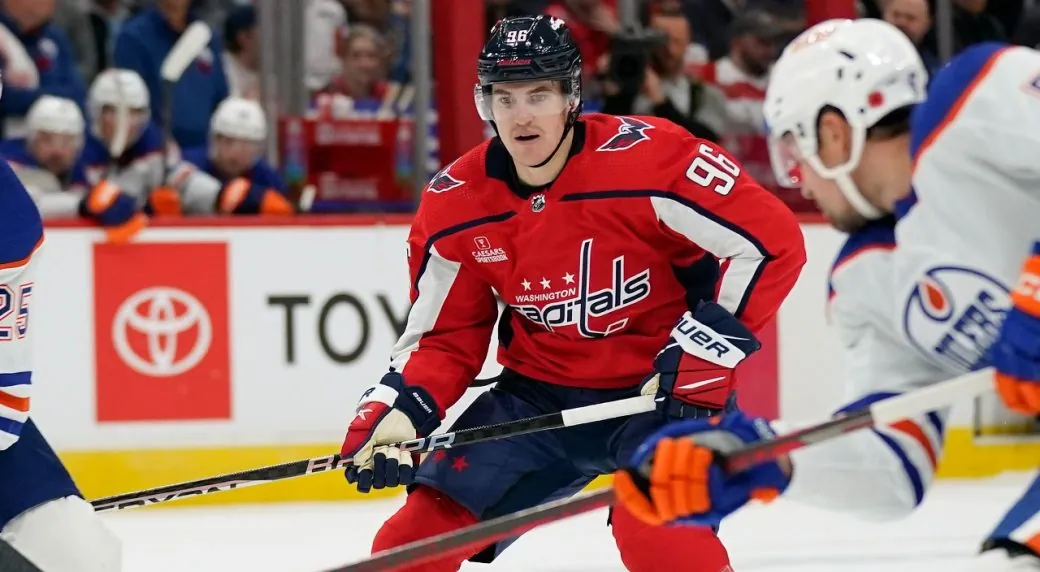
Photo: Patrick Semansky/AP
We continue our analysis of the performance of the Washington Capitals forward group for the 2022-23 season by taking a closer look at the performance of each and every line combination deployed last season as they relate to each individual forward.
The refined look attempts to glean additional insight into what worked and what didn’t work, on a line-by-line case, and assist in identifying specific “needs” the team might have for the upcoming season.
Previous Line Assessments:
- Alex Ovechkin
- Evgeny Kuznetsov
- Nicklas Backstrom
- Tom Wilson
- T.J. Oshie
- Nic Dowd
- Sonny Milano
- Dylan Strome
Today’s focus is on Nicolas Aube-Kubel. “NAK” recorded four goals and eight assists in 53 games played for the Capitals last season. He recorded a personal expected goals for percentage of 52.91% on the season, which was second-best on the Capitals.
ALL LINES DEPLOYED
The following graph plots all of the line combinations deployed with “NAK” for the 2022-23 season at five-on-five (sans lines that included Marcus Johansson, Lars Eller and Garnet Hathaway). The graph includes the total time each line was on the ice (TOI), the percentage of offensive zone faceoffs each line was on the ice for (OZFO%), the expected goals differential (xGF – xGA) and the expected goals for percentage (xGF%) deployed at five-on-five. [Click to enlarge].
[The statistics used in this post are courtesy of Natural Stat Trick and the NoVa Caps Advanced Analytics Model (NCAAM). If you’d like to learn more about the statistical terms used in this post, please check out our NHL Analytics Glossary]
Note: The thin horizontal red line above bifurcates the positive and negative expected goals for percentages for all of the line combinations.
WHAT WORKED
As we touched upon in the Alex Ovechkin and Dylan Strome assessments, the Ovechkin-Strome-Aube-Kubel line did well last season, recording an expected goals for percentage of 68.09% in 43.78 of time on ice at five-on-five. However, as with all Ovechkin lines, the trio saw a majority of their starts in the offensive zone.
NAK also did well on the fourth the line. The Protas-Dowd-Aube-Kubel line saw a significant amount of time on ice together and generated an expected goals for percentage above 50%, impressive for a line that saw a majority of their zone starts in the defensive zone, typical for a fourth line.
The Malenstyn-Protas-Aube-Kubel line is an interesting consideration of things to potentially come. The line saw just 15.03 of time on ice at five on five, but managed a respectable expected goals for percentage of 48.4%, all while seeing a majority of their zone starts in the defensive zone. If Malenstyn makes the team this fall, we should see a lot more of this line combination.
WHAT DIDN’T WORK
The Sheary-Dowd-Aube-Kubel line was NAK’s most deployed line combination (not including the players that departed at the trade deadline), but generated an underwhelming expected goals for percentage of just 45.10%. It should be noted that the line saw a majority of their starts in the defensive zone.
CONTEXT AND CAVEATS
It should also be noted that NAK did well deployed with Garnett Hathaway, but those line combinations have been removed for this series of assessments.
Aube-Kubel’s value is his replacement of Garnett Hathaway on the fourth line, and he should find his way to that spot to start the 2023-24 seas0n. He can also provide quality minutes on the top line and will likely see that again this seas0n, depending on the changes to the top-six this summer.
Next up is Anthony Mantha. At the end of this exercise we will compile the optimal line combinations for the Capitals from the 2022-23 season.
By Jon Sorensen