
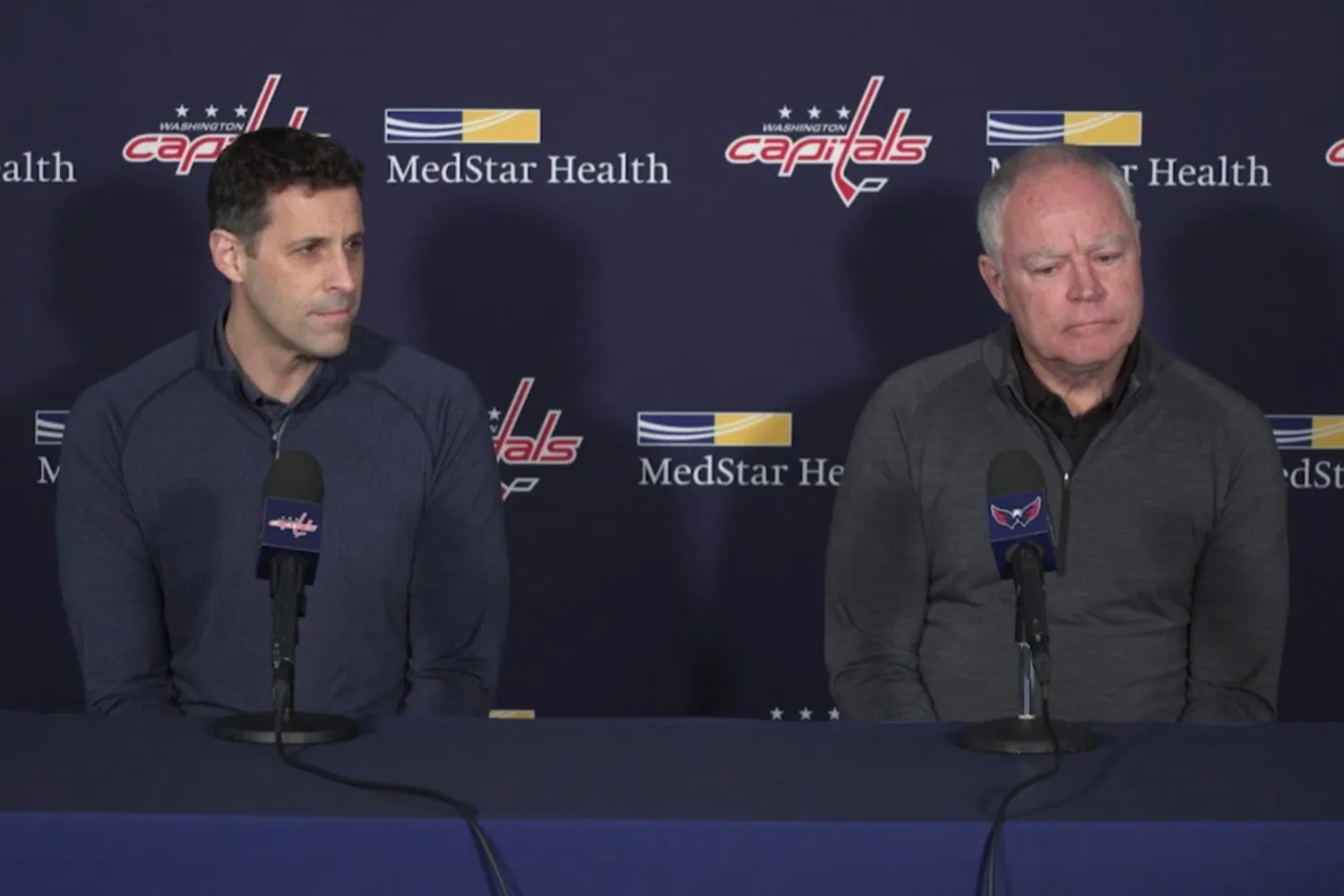
On Monday, the front-office duo running Washington — GM Chris Patrick along with hockey-operations president Brian MacLellan — held the franchise's customary wrap-up media session.
Predictably, the topic that consumed much of the discussion centered on what comes next for Alex Ovechkin. At 40 and a certain Hall of Famer, the winger has lately floated the possibility that his playing days aren't finished, yet he and Patrick have not sat down to map out anything specific. Such conversations, which during a typical year would already have taken place, were pushed back to grant Ovechkin space to sort through his thinking.
The just-finished year, the last on his current deal, marked just the fifth occasion across his two-decade-plus Washington tenure that the club fell short of the playoffs. The league's career goals leader has signaled he'd want some assurance the team aims to climb back into contention and pursue a championship before he agrees to suit up in 2026-27.
The two executives walked through those matters and several others, including how Ovechkin might fit into next year's roster, the involvement of owner Ted Leonsis in any negotiations, and the maneuvering room afforded by the sizable cap flexibility Washington brings into the coming offseason.
---
Full media session
Q: Ovechkin has hinted his career might not be over. Where does the organization land, and are you preparing two distinct summer roadmaps — one featuring him, one without?
Chris Patrick: Patrick explained that the club's position is to give Ovechkin room to decompress once the year ends, reflect, and consult his family before he meets with both himself and MacLellan, after which they'll back him through whatever he ultimately chooses. He said the team can map out a plan either way, comparing it to any offseason involving expiring players, where the front office charts different courses based on each outcome. The same logic applies to Ovechkin, he noted, even for the most prolific goal man in history — one direction if he returns, another if he opts to retire.
Q: He's emphasized that suiting up for a genuine title threat is important to him. In what way will you address that, and what's the message?
Chris Patrick: Patrick said the franchise is in a phase built around winning, that the current group is strong, and that the goal is to bring in additions that make it competitive and capable of chasing a championship — an aim he described as both their constant objective and one that will remain so.
Q: Have you set any deadline? Without pushing him, must an answer come ahead of the draft itself or by the time free agency opens?
Chris Patrick: Patrick said the ideal would be having clarity prior to draft weekend, but he stressed that Ovechkin has earned the latitude to handle the process on his own terms, so the club will work around whatever information it ends up receiving from him.
Q: Should he return, must there be a separate conversation pinning down the sort of role he'd hold entering the next campaign?
Brian MacLellan: MacLellan suggested much of that falls to the coach, while from the front office's standpoint the focus is on asking Ovechkin what he wants, how he'd like to proceed, what's driving his thinking, and what carries the most weight for him — then gauging his comfort level. From there, he said, Ovechkin together with the coaching staff and the organization would settle on the role to come.
Q: What's your evaluation of his on-ice performance this year? Sure, he paced the roster in scoring, yet the sport involves plenty beyond that.
Brian MacLellan: MacLellan said Ovechkin's presence is enormous and that his eventual exit will leave a substantial void on the personality and leadership fronts. He pointed to how Ovechkin carries himself on the team's plane, its bus, in the dressing area, and during pregame skates, describing that commanding presence as the chief factor in what he offers at this stage.
Q: Looking at the cap, should he stay, is there worry about both retaining Ovechkin and still landing the additional help the roster requires?
Chris Patrick: Patrick acknowledged the question seemed designed to corner him either way, but maintained the team is well positioned on the cap entering the offseason and has the flexibility to pursue various options depending on its priorities.
Q: Was the postponement of your sit-down intentional, meant to allow him breathing room once play ended? Under ordinary circumstances, would the meeting already have occurred?
Chris Patrick: Patrick said that in a typical situation they would have met already. They could have gotten together the moment the campaign wrapped, he noted, but he didn't think Ovechkin was ready for such a talk just yet. Fresh off a grueling 82-game grind, Ovechkin needed a stretch of downtime alongside family before shifting his focus toward what lies ahead.
Q: Does the ownership figure, Ted Leonsis, get directly involved in hashing these matters out alongside Ovechkin?
Brian MacLellan: MacLellan confirmed Leonsis would be involved, adding that discussions had taken place both once play wrapped and during the stretch leading toward the finish. Ownership has spoken with Ovechkin, and MacLellan said he had too, wanting to gauge where Ovechkin's head was at.
Q: Has the league itself been inquiring about the situation? A comeback on his part would carry real weight for its own scheduling.
Brian MacLellan: MacLellan agreed that was the case, citing the volume of national television exposure the team received this year, which he attributed largely to Ovechkin.
Q: The impression was that he delayed any announcement to sidestep an elaborate send-off. Has the topic surfaced at all? Does he actually mind either way?
Brian MacLellan: MacLellan admitted he wasn't sure, guessing Ovechkin is probably of two minds about it. Offering his own view, he said wrapping up a career is hard on any athlete, even more so for someone of Ovechkin's standing, and that grappling with how to exit the game must be a tough thing to navigate.
Questions have been condensed and clarified.