
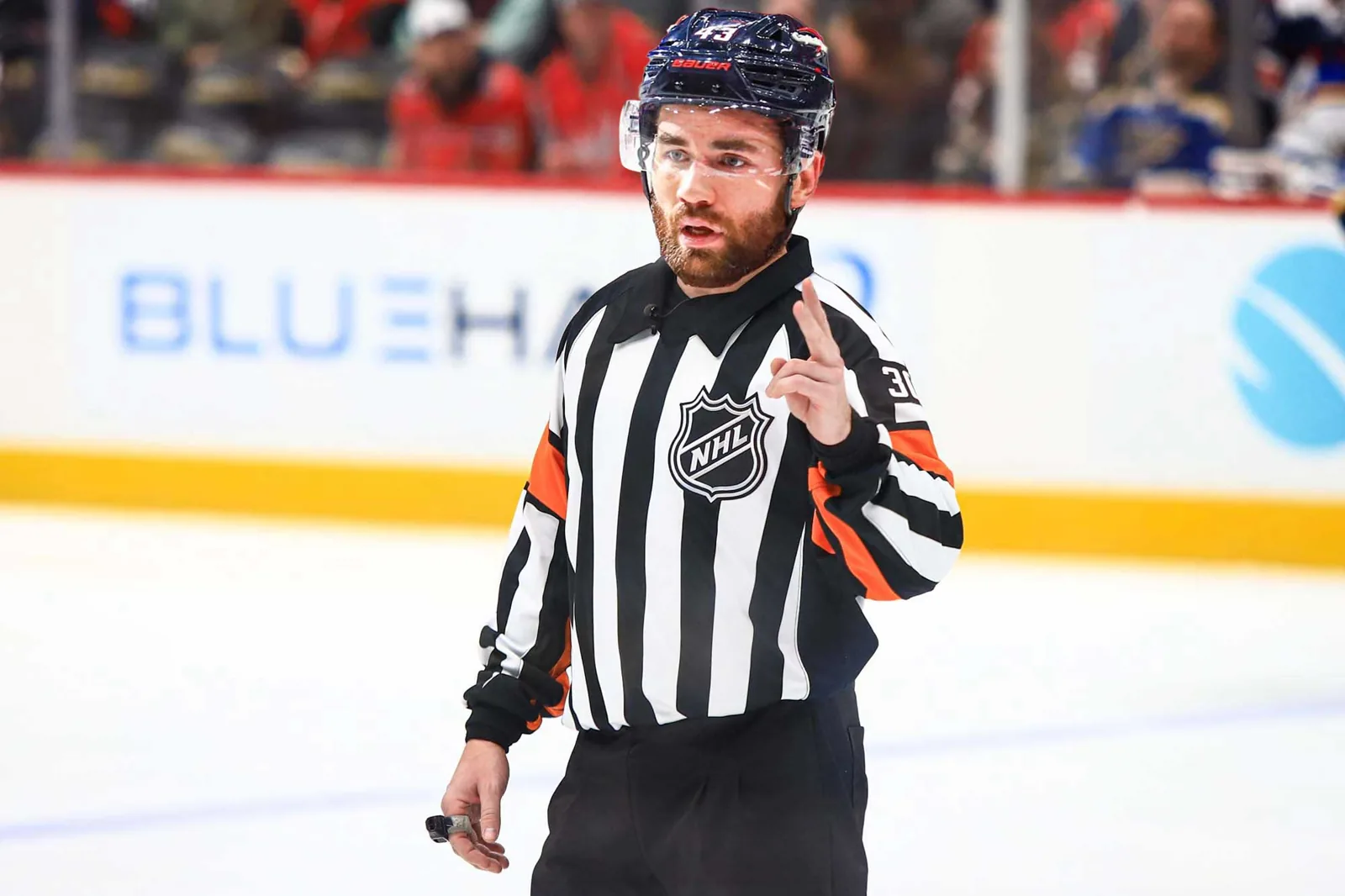
ARLINGTON, VA — For the most part, the NHL's rulebook makes for fairly tedious reading. Stretching to 232 pages, it lays out every fine point of the sport, covering everything from how the rink is measured to how faceoffs are conducted.
Lately, though, one rule that usually slips everyone's mind has caught the hockey world's eye, mostly because it's just plain fun: skaters serving as officials.
A game can still go on with one referee short — hardly a rarity when somebody on the crew gets hurt — but matters get trickier once several officials are unavailable. Under NHL rule 31.11, should the league fail to round up proper substitutes, the final fallback has both clubs each tab one of their own skaters to pull on the stripes.
The provision states that if illness or mishap keeps the assigned Referees and Linespersons from showing up, the League will do everything possible to locate fitting replacement officials; failing that, the Managers or Coaches of the two Clubs are to settle on Referee(s) and Linesperson(s). Should they fail to reach agreement, each side designates one of its skaters to fill those roles, with the home Club's skater serving as Referee and the visitors' skater as Linesperson. The rule adds that the moment the properly assigned officials turn up while play is underway, they immediately take over from the stand-in officials.
Attention to the rule spiked after Islanders supporter Nicole Shirman unearthed it last week, catching even NHL players off guard.
Shirman wrote on social media that she had just discovered a genuine NHL rule under which, if the officials never show for whatever reason and nobody can settle on stand-ins, each side simply taps a skater — the host team's guy taking the referee duties while the road player works as linesman (March 12, 2026).
Ethen Frank told RMNB he couldn't believe such a rule existed, saying he'd had no clue about it.
So which name would Washington tap if it ever came to that? Nearly every guy offered up someone different.
Speaking with RMNB, Pierre-Luc Dubois said the gig calls for someone gutsy enough to absorb an hour of abuse, and his pick would likely be Charlie Lindgren, whom he calls Chuckie.
Dubois chuckled, then doubled down, insisting Chuckie was unquestionably his choice and that he couldn't see anyone else handling it.
His pick mirrored a pattern that ran through the dressing room: most guys named teammates they trusted to officiate honestly. Frank singled out Tom Wilson, noting that his dad works as an official in Toronto's Greater Toronto Hockey League (GTHL), and describing him as a guy who brings a pretty even-keeled view of penalties.
Frank said he'd go with Willy, while noting the nod surely would have gone to Carlson — Johnny — during his time there. Still, he figured Wilson would do the role justice, describing a player who tolerates no nonsense and officiates fairly.
Frank explained that even when the Capitals get whistled and the players start barking at the officials, Wilson tells them flatly that the infraction was real and that they ought to level with themselves. For that reason, Frank said, Wilson is probably the most truthful of the bunch, adding that he was certain a few teammates would dish out plenty more man-advantages than others.
And the worst candidate? Frank named Dewey, or maybe Leno, joking that the pair see a penalty on every play. He set the netminders apart from that group but reckoned the duo would top the list.
Hendrix Lapierre needed a moment with the question, even getting back on his feet to scan the room before settling on the well-known tough guy Dylan McIlrath, pointing to intimidation as the deciding factor.
Lapierre landed on Mac, explaining that players would hold tremendous respect for him, wouldn't dare act up, and that he'd be plenty fair in his view.
Lapierre had a point: it's tough to picture anyone starting a fight with official Dylan McIlrath. As Lapierre laid out his case, Dylan Strome chimed in to push back, and the two got into it.
Strome questioned whether McIlrath actually knew every rule. Lapierre insisted Mac did know them, then turned it around and asked Strome for his own pick. Strome nominated himself, which Lapierre flatly rejected as having no shot. Lapierre conceded Strome ranked among the players who read the game properly but maintained Mac was his top selection. Strome agreed Mac was a strong call, granting that he understands the game and that nobody would tangle with him. Lapierre drove the point home, saying McIlrath commands respect and that no one would be hollering at him for a full hour — he'd snap your neck first.
Strome himself proved to be among the answers that came up most often. His name popped up while Ryan Leonard, alongside teammate Anthony Beauvillier, weighed the matter, even as Leonard also floated Frank for his quickness, plus Roy, among the worthy candidates.
In their back-and-forth, Leonard led with Roy, saying he calls it clean, then asked Beauvillier for his choice. Beauvillier said he'd want someone with strong integrity, and Leonard agreed that was his thinking, sticking with Roy. Beauvillier called Roy a good selection but said he leaned toward Stromer for his vision. Leonard wrapped up by listing Stromer or Roy, and maybe Franky — the fastest official on the planet.
While most of the room opted for teammates they expected to officiate fairly, Spencer Carbery, the bench boss, took the reverse tack. He pointed to Vegas's Bruce Cassidy, a coach who fielded an identical query by judging which of his spare skaters would lean hardest in his club's favor.
Carbery said he had just seen that clip and called it a deeply unfair question, noting that Cassidy started weighing his scratches because he couldn't afford to lose a guy from his lineup, before trailing off.
Capitals communications chief Sergey Kocharov cut in to tell Carbery not to answer, which drew laughter from the assembled reporters.
Carbery agreed it was sound counsel, repeating that it was good advice.
Still, freed from the constraint of healthy scratches, Carbery figured Strome would find some means of tilting things toward a Washington win.
Carbery said that if he were choosing a single skater off the roster — setting aside whether the guy could even play — he'd take Dylan Strome, echoing the idea of leaning toward your own side. Strome, he said, would make certain the team picked up a few bonus power plays.
Logan Thompson stood apart from both schools of thought: rather than weighing fairness one way or the other, he leaned toward whoever would deliver the best entertainment value. Thompson said he'd station Duhaime on the lines and would relish watching Wilson handle the whistle, curious how a guy who enjoys needling the zebras would fare and how composed he'd remain. As for Duhaime, Thompson said he'd love sticking him somewhere he couldn't whistle anybody while the players razzed him, calling it a comical scenario.
Nowadays, an officiating shortage spiraling far enough to put skaters in stripes seems remote, yet it has happened before. The date was January 16, 1983, when a six-inch snowfall stranded a pair of that night's trio of officials. Stepping in to cover briefly were a pair of skaters: Mickey Volcan, a defenseman for the Hartford Whalers, and Garry Howatt, a forward with the New Jersey Devils.
According to Secret Base, which back in 2018 released a clip breaking down the rule, Volcan went so far as to eject one of his own from a draw. The duo handled the lines — the lone linesman who had turned up got bumped up to interim referee — right until the absent zebras reached the rink ahead of the middle frame.
DC will hopefully steer clear of additional snow this winter, but it's comforting that, should the call come, Washington's group stands ready to step up.