
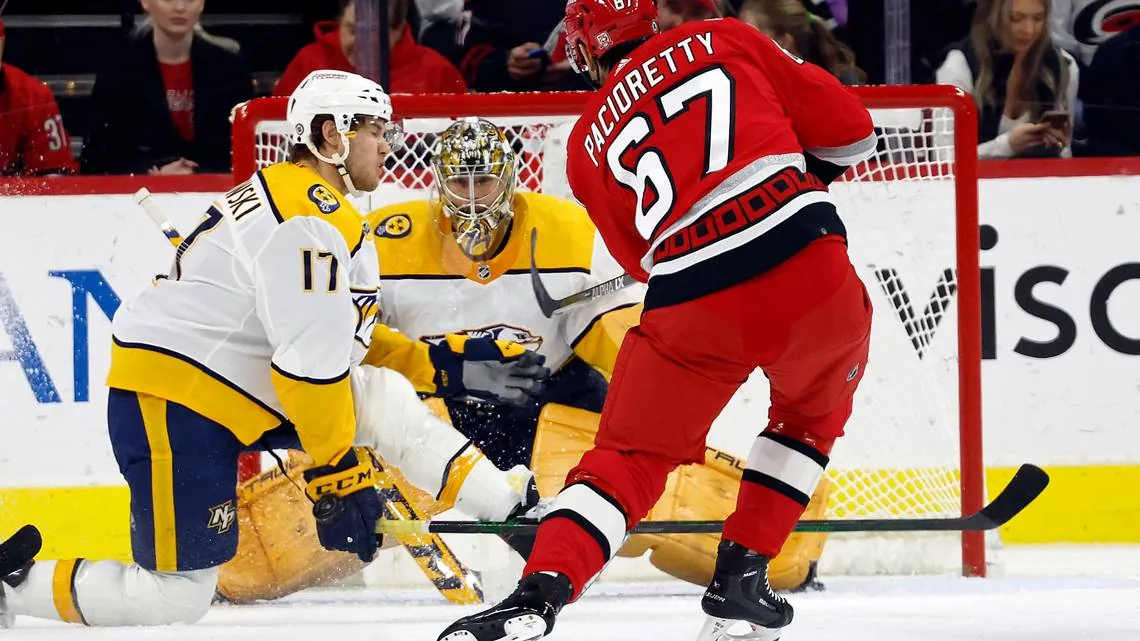
Photo: News Observer
On the opening day of unrestricted free agency, the Washington Capitals made two moves in hopes to improve the team after missing the playoffs for the first time in a decade. The moves addressed both offensive and defensive needs.
At the end of the regular season, Capitals’ General Manager Brian MacLellan noted that he hoped to improve the top-six forward group by potentially adding one or two players to come in and help add more scoring. MacLellan also wanted to add a bit more youth to the roster. The two moves we’re covering today don’t really help the average age of the team very much, but one definitely addresses the top six forward need while the other addresses the lack of experience on the left side of the defense. In this post, we’ll be diving into the underlying metrics for Joel Edmundson and Max Pacioretty.
The statistics used in this post are courtesy of Natural Stat Trick, Evolving Hockey, and the NHL. Contract and salary cap information is courtesy of CapFriendly. If you’d like to learn more about the statistical terms used in this post, please check out our NHL Analytics Glossary.
Joel Edmundson
The Capitals’ first move of the day was acquiring left-handed defenseman Joel Edmundson from the Montreal Canadiens. The Capitals acquired Edmundson (with 50% of his salary retained) for Minnesota’s 2024 3rd round pick (acquired in the Marcus Johansson trade) and the Capitals’ 2024 7th round pick. Edmundson’s cap hit for the last year of his contract is $1.75M.
In my opinion, it’s more than likely that the Capitals wanted to add a bit more physicality to the defensive corps, and Edmundson can bring that physicality. Edmundson is 6-foot-five-inches and weighs 221 pounds, so he can bring that net front presence that the Capitals were sorely missing last season.
On top of that, Edmundson was 68th in the NHL among defensemen in hits (112) and 24th in the NHL among defensemen in blocked shots. I’d expect Edmundson to slot into the third pairing alongside Trevor van Riemsdyk.
Let’s take a look at his underlying possession metrics from last season with the Habs:
When we take these statistics at face value, they are definitely pretty woeful numbers for Edmundson. It’s paints the picture of a player that struggles at both ends of the ice and can’t keep the puck out of his own net.
Let’s rip the band-aid off and look at his five-on-five chance generation metric performance from last season:
This compounds the struggles that Edmundson faced in Montreal last season. There’s not a lot of good to talk about here, so instead, let’s look at the context around Edmundson’s performance last season.
Edmundson was playing a larger role on the blue line for the rebuilding Habs, and the Habs did not put forth a successful season last year. First, let’s take a look at Edmundson’s Regularized Adjusted Plus Minus (RAPM) chart, which compares the performance of key metrics posted by a player to the league average:
Again, these show what we’ve seen in the raw percentage based metric performance above. We know Edmundson wasn’t setting the world on fire in Montreal. But, I wanted to show you Edmundson’s RAPM chart before I showed you Montreal’s team RAPM chart, which may clear up a bit of concern around the acquisition:
Montreal was really bad last season. As a more defensive focused defenseman, Edmundson can only do so much when the rest of the roster around him struggles in pretty much every situation on ice. To add a bit of clarity around the player we know Edmundson can be, here’s his RAPM chart from the 2020-21 season, where he had some success:
If the Capitals can get a bit more of the 2020-21 season iteration of Edmundson, the Caps could do a lot worse for a third pairing defenseman. To note, the 2020-21 iteration of the Montreal Canadiens ended up making it to the Stanley Cup Final, and Edmundson played a large role in their Cinderella story. He averaged 20:03 in time on ice per game that season, so he was firmly in their top defensive pairings.
To show his on-ice impact, let’s take a look at his isolated impact chart from HockeyViz for last season:
Again, at face value, these don’t really look too good. On the other hand, though, Edmundson routinely played against opponents’ top talent and didn’t necessarily have the supporting talent around him to help him be successful.
I want to show what Edmundson can do when he’s in a position to succeed, so here’s his isolated impact chart from the 2020-21 season:
Edmundson definitely wasn’t setting the world on fire, offensively, but his deployments resulted in 5% fewer expected goals against per sixty minutes (xGA/60), which is pretty much what you want from a defensively focused defenseman. In a smaller role on the third pairing, Edmundson should be able to return to something a bit closer to his 2020-21 self.
Max Pacioretty
In their lone signing of the day in unrestricted free agency, the Capitals signed left wing Max Pacioretty to a one year deal that carries a $2M cap hit. The structure of the deal also includes $2M in performance bonuses based off of games played. If Pacioretty plays in 20 or more games this season, he’ll get the full $2M performance bonus. That bonus will apply to the Capitals’ salary cap in the 2024-25 season.
Pacioretty is coming off a complete tear of his Achilles (for the second time on the same ankle), and will likely not be available at the start of the season. Pacioretty only played in five games for the Carolina Hurricanes last season, but scored 3 goals in that time frame. In his career, Pacioretty has scored 326 goals and 319 assists for 645 points in 855 career games. Pacioretty will turn 35 in November this year.
Although Pacioretty is on the older side, and most fans might be confused about signing another veteran on the back nine of his career, his performance is still very good when he’s healthy.
Let’s take a look at his underlying possession metrics from the 2021-22 and 2022-23 seasons (since he only played in five games last season):
Like I mentioned, Pacioretty had only played in five games before re-tearing his Achilles tendon, but he was utterly dominant in those five contests. His possession metrics may be a bit inflated because of Carolina’s puck possession strategy around quantity over quality of shot attempts, but they also controlled all of the goals scored when Pacioretty was on the ice.
Even looking back to his 2021-22 season with the Vegas Golden Knights, Pacioretty posted really strong performances in possession metrics across the board. If Pacioretty can stay healthy, the Capitals just signed a bonafide goal scorer for their second line, and a left handed goal scorer for the power play.
Here’s Pacioretty’s scoring chance generation metrics for the past two seasons:
Again, these are really solid performances. Outside of allowing a bit more high danger chances (HDCF%) against in Vegas during the 2021-22 season, everything is on the right side of 50% here.
Here’s Pacioretty’s RAPM chart from last season:
This is a bit off since Pacioretty played so few minutes last season, but one of the key takeaways here is that his xGA/60 is trending a bit higher than his expected goals for per sixty (xGF/60). Pacioretty is actually rather effective defensively, and we can see that in a bit.
Here’s Pacioretty’s RAPM chart from the 2021-22 season:
We see the opposite relationship between xGF/60 and xGA/60 from last season, but we also see a player that was really effective in generating Corsi shot attempts for (CF/60), and ended up being close to one standard deviation above league average in xGF/60. Pacioretty, even in his mid-30s, is still an effective player.
Here’s Pacioretty’s isolated impact chart from last season:
The Hurricanes were considerably better when Pacioretty was on the ice in both offensive and defensive situations during even-strength, particularly offensively. The 12% increase in xGF/60 might be a bit inflated because of the low sample size of game action last season, but there’s still something there worth watching for next season with the Capitals.
Here’s his isolated impact chart from the 2021-22 season:
In all, we can look at his small sample size from last season and compare it to the 2021-22 season where he played 39 games and say that we’re seeing a trend of positive impacts at both ends of the ice during even-strength situations.
Bringing a 14% increase in xGF/60 in isolated impact is considerable, and if the Capitals can get that level of performance and production next season, the Caps should be in a good spot to contend for the playoffs.
Overall takeaways from the acquisitions
I’m cautiously optimistic about Joel Edmundson, considering it’s a rather low risk acquisition for a player that you hope can bounce back with a better team around him. With only a year left on his deal, and with 50% of his salary retained, you’re probably getting a more cost effective player for the third pairing (with a solid amount of NHL game experience) than you would in trying to sign a player in free agency. For the mere cost of a third round pick and a seventh round pick, it’s worth a gamble. Worst case scenario, he doesn’t perform well and Alexander Alexeyev gets playing time instead.
For Pacioretty, I’m pretty excited about the idea of him playing in a Capitals uniform. Yes, he’s 35. He’s a bit older than what I ideally would have liked the Capitals to go out and get for a long term top six option. On the other hand, though, Pacioretty performs really well when he’s healthy (and that’s a big caveat for him). Absolute worst case scenario for Pacioretty is he can’t stay healthy and the Caps put him on the long term injury list. The other possibility is if the Capitals are again outside the playoffs come the trade deadline and could recoup some assets in a Pacioretty trade to a contender if he’s performing well and is healthy.
By JustinTrudel