
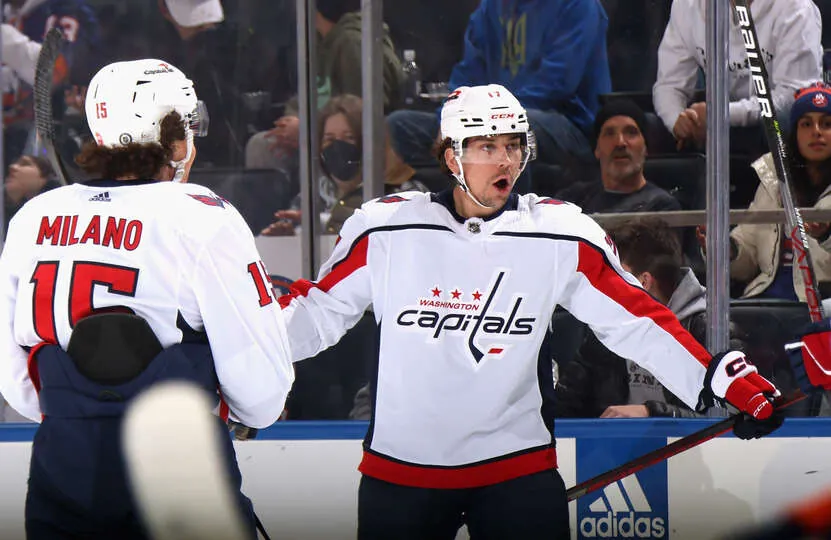
Photo: Bruce Bennett/NHL via Getty Images
In the next segment of posts evaluating the overall 2022-23 season for the Washington Capitals, we’re going to break down the forward group by age group: under 30 years old and over 30 years old. The main point for this delineation is to evaluate players either entering their prime or reaching the end of their prime years versus players who are in their post-prime years.
The statistics used in this post are courtesy of Natural Stat Trick, Evolving Hockey, Hockey Reference, Dobber Sports, and HockeyViz. Contract and transaction information are courtesy of CapFriendly. If you’d like to learn more about the statistical terms used in this post, please check out our NHL Analytics Glossary.
DYLAN STROME
First up in our evaluation is center Dylan Strome. The Capitals found a gem in the bargain bin in free agency last season after the Chicago Blackhawks unceremoniously released Strome after deciding to non-tender him as a restricted free agent. The Caps swooped in and signed Strome to a one-year contract with a $3.5M cap hit. Strome’s contributions to the top six forward group ended up netting him a five-year extension during the season, which will carry a $5M cap hit through the 2027-28 season.
Strome posted career highs in goals (23), assists (42), and points (65) in 81 games this season. Not too shabby for a guy who was non-tendered by his previous club.
Five-on-Five Possession and Chance Generation
Let’s take a look at how Strome fared in key underlying metrics around puck possession and scoring chance generation:
Strome definitely had his struggles in the possession category this season, even with 71.92% of his zone starts occurring in the offensive zone. With the opponents’ carrying the majority of Corsi shot attempts for (CF%), Fenwick shot attempts for (FF%), and overall shots on goal (SF%), it’s no surprise that Strome’s expected goals for percentage (xGF%) is slightly below the 50% threshold.
On the positive end of the spectrum, Strome was on the ice for a higher percentage of goals for (GF%) that outpaces his xGF% by over 4%. This indicates that the Caps finished at a higher than expected rate while Strome was on the ice. With that, the Caps also controlled a higher share of high-danger chances for (HDCF%) and converted that share into controlling the majority of high danger goals for (HDGF%) while on the ice.
In a season where the top six forward group struggled to be productive (outside of Strome and Alex Ovechkin), it’s not a huge surprise to see possession rates falter a bit.
Rate-Adjusted Plus Minus (RAPM)
Here’s Strome’s Rate-Adjusted Plus Minus, which is used to compare a player’s performance in key metrics at a rate of sixty minutes of play to the league average:
Overall, Strome was a key contributor in the top six this season, which should secure him a spot in that group next season. He’s impactful during five-on-five play and during the power play.
One thing to point out here is that although Strome’s Corsi shot attempts for per sixty (CF/60) is above the league average by nearly an entire standard deviation, his Corsi shot attempts against per sixty (CA/60) trails below league average. This indicates that his possession metrics trail below 50% in the data we covered previously because the Caps were giving up more shot attempts against than the Caps were attempting, even though Strome got very offensively favorable zone deployments.
Isolated Impact
Here’s Strome’s isolated impact that displays the Capitals’ performance with Strome on the ice versus the Caps performance with him off the ice:
We know that Strome adds value offensively, so seeing a +6% lift in xGF/60 when he’s on the ice isn’t necessarily surprising. I’d like to point out the -1% drop in power play performance in xGF/60: this was a team-wide issue during the power play, and likely a major reason why the Caps and long-time power play coach Blaine Forsythe parted ways.
In terms of even strength defense, the +1% actually indicates that the Caps were a bit worse defensively when Strome was on the ice. Now, this is kind of expected considering he was mainly deployed on a line with Alex Ovechkin and Conor Sheary, and neither of those players are perennial Selke candidates.
ANTHONY MANTHA
Mantha was acquired on April 12, 2021 in a trade with the Detroit Red Wings that cost the Capitals Jakub Vrana, Richard Panik, Washington’s 2021 first round pick, and the Caps 2022 second round pick. It’s clear that the Capitals didn’t win this trade, but the move was made to bring in a bigger bodied offensive presence to better fit Laviolette’s system. It was also clear during the 2022-23 season that Mantha fell out of favor with Laviolette, being healthy scratched at points this season.
Mantha is entering the final year of his contract which carries a cap hit of $5.7M. With the Caps entering this off-season expecting to scour the trade market for top six forward help, it’s unclear if the Caps will move Mantha for more cap space, or will gamble on the next coaching staff to help him rebound from a disappointing season offensively.
This season, Mantha posted 11 goals and 16 assists for 27 points in 67 games played. If the Caps choose to retain him, they’d love to see Mantha revert back to the player he was after they acquired him from the Red Wings, where he posted 6 points in his first seven games as a Capital.
Five-on-Five Possession and Chance Generation
Let’s take a look at how Mantha fared in key underlying metrics around puck possession and scoring chance generation:
Based on the disappointment around Mantha’s performance this season, it might be surprising to see how effective he was in virtually every underlying metric outside of GF%. To me, this doesn’t indicate that Mantha is an ineffective player, but a player that was pretty unlucky this season when it came to scoring. He shot a career low 9.2% this season, which sits 3.4% below his shooting percentages in 2016-17 and 2017-18 where he scored 24 and 25 goals respectively.
By all appearances here, Mantha is doing the right things on the ice, he’s just not being rewarded in the box score. We know that Mantha has dealt with confidence issues this past season, and perhaps a new coaching staff can bring back his confidence level.
Rate-Adjusted Plus Minus (RAPM)
Here’s Mantha’s RAPM chart:
This basically mirrors what we covered above: he’s actually posting some really strong possession based numbers, he’s just struggling in scoring. He’s also very effective defensively. That only gets you so far with a team and a fanbase though, especially when you’re being paid top six forward money to score goals.
I’m not putting a lot of stock in Mantha’s performance on the power play. He didn’t get a lot of opportunities there, and the Caps power play struggled as a whole this past season.
Isolated Impact
Here’s Mantha’s isolated impact chart:
In even-strength offense, it’s not surprising to see he has a +3% impact on xGF/60. He was effective on the ice in creating chances, the issue was finishing. He’s a three-time 20 goal scorer, so we know he can score. This is a confidence issue through and through, especially due to being placed in the proverbial doghouse by Laviolette.
The biggest impact, as we’ve mentioned for Mantha previously in this post, is defensively. His impact on the defensive end of the ice results in -8% fewer expected goals against per sixty (xGA/60), which means he’s paying attention to in-zone defensive assignments and is thriving there.
SONNY MILANO
Milano was another bargain bin win for Brian MacLellan, signing him to a one-year contract with a $750k cap hit on October 15, 2022. Milano was an important part of replacing injured players in the lineup, like Connor Brown (who tore his ACL in his fourth game of the season).
Milano was then extended during the season to a three-year contract with a cap hit of $1.9M that runs through the 2025-26 season. Milano posted 11 goals and a career-high 22 assists for 33 points in 64 games played this season.
Five-on-Five Possession and Chance Generation
Let’s take a look at how Milano fared in key underlying metrics around puck possession and scoring chance generation:
Overall, Milano didn’t post the strongest underlying metrics this past season despite having a 65.47 offensive zone start percentage. The only two metrics that surpassed the 50% threshold were CF% and HDGF%. With how far his HDGF% outpaces his HDCF%, it’s fairly safe to consider this performance unsustainable in the long run.
Part of Milano’s struggles in some of these key categories was that he never really found a long-term line combination that received any substantial time on ice together. The line he spent the most time on was with TJ Oshie and Evgeny Kuznetsov (90:50 of TOI), and that line really struggled to put it all together, posting a 33.8 SF% and a 40.8 CF%.
His best overall line was his third most utilized, in a trio with Mantha and Kuznetsov where they had a +2 goals differential, 55.4 SF%, and 55.2 CF%. It’s probably not great for Milano that his best line combination in terms of sample size and performance is with two of the players that are potential trade candidates this off-season.
Ultimately, a large contributor to Milano’s struggles in these key underlying metrics is the constant changing of lines that were enacted by former coach Peter Laviolette, due to players entering the lineup after recovering from injuries, players leaving the lineup due to injuries, or roster shakeups through trades.
Rate-Adjusted Plus Minus (RAPM)
Here’s Milano’s RAPM chart:
The only metric coming in below league average is his CF/60, which isn’t too shocking considering the metrics we just covered for him in the previous section. What we like to see is his GF/60 outpacing his xGF/60 considerably, which indicates a higher rate of finishing. The lack of finishing ability really haunted the Caps this season, and that is going to be a metric that the Caps will have to remedy this off-season.
Isolated Impact
Here’s Milano’s isolated impact:
The key takeaway here is that Milano is really effective offensively, translating to a +7% xGF/60 impact on the Caps while on the ice while also not sacrificing on the defensive end of the ice. The Caps were effectively no worse on the defensive end of the ice with Milano deployed, which subverts the notion that Milano just isn’t effective defensively. He’s not going to be in the running for the Selke anytime soon, but the fact that he can contribute offensively while not being a complete defensive liability is a value add.
ALIAKSEI PROTAS
Protas was drafted in the third round of the 2019 NHL Entry Draft. Protas saw his first NHL action in the 2021-22 season, appearing in 33 games in that campaign. Protas made the Caps’ roster out of training camp this season, and appeared in 58 games this season before being sent back and forth from Hershey after more players recovered from their long-term injuries.
Protas is entering the final year of his entry-level contract, with a cap hit of $789,167. Protas posted career highs in goals (4), assists (11), and points (15) this season.
Five-on-Five Possession and Chance Generation
Let’s take a look at how Protas fared in key underlying metrics around puck possession and scoring chance generation:
Protas posted very effective underlying metrics this season, with all but one of his underlying metrics breaking through the 50% threshold. Considering the vast majority of his ice time coming on a line with Nic Dowd and Garnet Hathaway, you could see why his xGF% was considerably high: that trio was really effective in controlling the puck in the offensive zone against top offensive lines. The reason GF% trails a bit there is that that trio didn’t finish at a very high rate although they controlled the lion’s share of shot attempts.
At a high level, this is pretty much exactly what you want out of a young, bottom six forward. He’s playing the right way, and if the line he’s deployed on can cash in on the scoring chances they generate, they could be one of the best bottom six lines in hockey.
Rate-Adjusted Plus Minus (RAPM)
Here’s Protas’ RAPM chart:
What we can see here is a player that is really effective in his own zone. With his xGA/60 coming two standard deviations above league average, he’s a very effective shutdown forward. If he can learn to engage a bit more physically while staying in position and not giving up chances for a big hit, Protas can be even more effective.
The largest area for improvement for Protas is in scoring, but we’re not sure what that ceiling looks like. He scored 31 goals in 58 games in the WHL for the Prince Albert Raiders, but that’s a whole different ball game from the NHL (and even the AHL). We don’t have a full season in the NHL or AHL to base a potential goal scoring level for Protas yet, but considering he’s 22 and is still finding his feet in the professional leagues, it’s not out of the realm of possibilities that he could be a 10-15 goal scorer when he enters his prime years.
Isolated Impact
Here’s Protas’ isolated impact:
The Capitals were effective in creating chances while Protas is on the ice, as indicated by the +3% increase in xGF/60 and the metrics we covered a bit earlier. And to no one’s surprise, his deployments result in -8% fewer xGA/60.
Protas is deserving of a larger role on the penalty kill next season. It’s pretty mind-blowing he wasn’t used more in that situation this past season, only accruing 12:21 in TOI while the Caps were shorthanded.
NICOLAS AUBE-KUBEL
Aube-Kubel (who I’ll be referring to as NAK from here on out) was acquired via a waivers claim from Toronto on November 5th, 2022. NAK’s current contract expired with a cap hit of $1M and was subsequently extended on March 3rd, 2023 for a year with a $1.225M cap hit.
NAK posted 4 goals, 8 assists, and 12 points in 53 games this season, with all of his points coming in 47 games played with the Capitals.
Five-on-Five Possession and Chance Generation
Let’s take a look at how NAK fared in key underlying metrics around puck possession and scoring chance generation:
NAK is another example of thriving in underlying metrics during five-on-five play. All but his HDGF% exceeded the 50% threshold. With his HDGF% trailing 5.4% behind his HDCF%, it’s likely due to a lack of offensive finish and a bit of bad luck when it comes to goaltending.
Overall, NAK looks to be a really effective fourth liner for the Capitals. You could do a lost worse than a potential trio of Protas, Dowd, and NAK as your shutdown line.
Rate-Adjusted Plus Minus (RAPM)
Here’s NAK’s RAPM chart:
We can tell that NAK’s performance in the underlying metrics presented prior to this section that he’s just really effective defensively. His higher percentages in CF%, FF%, and SF% are mostly due to a high rate of shot attempt suppression than due to an excess of shot attempts for. This is the same type of scenario with GF% versus xGF%. He’s really effective in shutting down offensive threats and overall shot attempts against.
Isolated Impact
Here’s NAK’s isolated impact:
This kind of drives my prior point home: NAK isn’t really an offensive threat (with a -2% impact on xGF/60), but a true shutdown forward (-6% impact on xGA/60). It’ll be interesting to see if the next coaching staff wants to use NAK on the penalty kill a bit more, especially since we’ve seen some more offensively focused players like Sheary and Kuznetsov on the penalty kill this season instead of true shutdown forwards like NAK and Protas getting those deployments. Why risk exhausting your offensive talents (or exposing them to injury) when you have very effective defensive forwards sitting on the bench for the PK?
TOM WILSON
Tom Wilson was drafted 16th overall in the first round of the 2012 NHL Entry Draft (wow, yeah it’s been that long). After his entry level contract expired after the 2015-16 season, the Capitals signed him to a two year contract with a cap hit of $2M. After Wilson blossomed into a true top six power forward during the course of that two year contract as well as being an instrumental piece for the Caps’ 2018 Stanley Cup, the Capitals extended Wilson to a six year contract that carries a $5,166,667 cap hit through the 2023-24 season.
With Wilson entering the final year of his contract (which will see him become an unrestricted free agent at the end of next season), both MacLellan and Wilson have made no bones about Wilson staying with the Caps for the foreseeable future. It’ll be interesting to see what that next contract looks like for Wilson.
Wilson returned to the lineup in January 2023 after recovering and rehabilitating his ACL injury. In 33 games this past season, he scored 13 goals and dished out 9 assists, good for 22 points.
Five-on-Five Possession and Chance Generation
Let’s take a look at how Wilson fared in key underlying metrics around puck possession and scoring chance generation:
This wasn’t exactly the performance you’d like to see from Wilson at this point in his career, but it’s also beyond fair to point out that he returned from a long absence due to his ACL tear, and then suffered a broken bone in his ankle/lower leg shortly after blocking a shot.
That being said, Wilson’s overall metrics were likely being negatively affected by seeing most of his ice time on a line with Kuznetsov and Ovechkin, where they posted a 44.3 CF% and a 38.6 SF%. Wilson actually fared a lot better when on a line with Strome and Ovechkin, posting a 52 CF% and a 56.3 SF%. MacLellan also referenced in his post-season press conference that he liked when Strome and Wilson were together on a line, and these metrics really show that effectiveness together.
Rate-Adjusted Plus Minus (RAPM)
Here’s Wilson’s RAPM chart:
Again, this isn’t exactly what you’d want to see from Wilson, but the sample size was considerably smaller and more volatile for him this season. He missed the real peaks of the team’s performance in December 2022 and was only really present in the lineup when the team as a whole was suffering through bad performances leading to the team selling at the deadline.
Isolated Impact
Here’s Wilson’s isolated impact:
I don’t think this visual is indicative of Wilson’s value on the ice, especially through his career. He’s proven to be a responsible top six forward defensively and chips in offensively at a consistent rate. There’s two factors that really impacted his performance this season: recovering from two separate injuries and having the majority of his games played coming when the Caps were effectively out of playoff position with nothing to really play for. I’d expect pretty substantial improvement for Wilson next season, especially with it being a contract year.
Overall Takeaways
The Caps don’t have a lot of forwards who played considerable games this season who are on the younger side of the current roster. The key for the Capitals to be successful next season is to get as much as they can out of their younger players they currently have in the lineup while infusing even more youth to counterbalance the aging veteran core group.
Eyes will be on the Caps this off-season, where they figure to add one, maybe two, top six forwards that are on the younger side. In order to do that, they’ll have to either find a player on a relatively cheap contract, or they’ll have to move money out. It’ll be interesting to see what decision MacLellan makes on Mantha and his contract. Kuznetsov is another expensive contract for a player that might have seen his time in DC come to a close after a pretty underwhelming season for what he can deliver when he’s at his best.
By Justin Trudel