
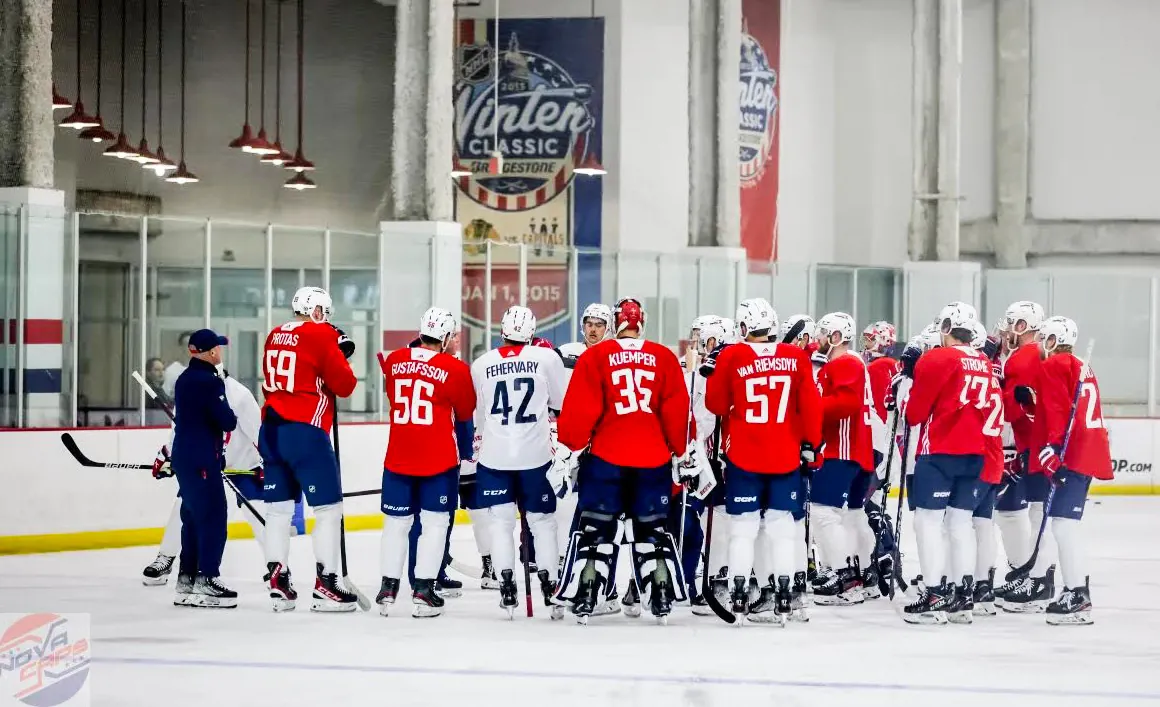
The Washington Capitals currently have seven players on their NHL active roster (excluding Beck Malenstyn) who are 26-years-old or younger: Dylan Strome, Nicolas Aube-Kubel, Aliaksei Protas, Sonny Milano, Rasmus Sandin, Alexander Alexeyev, and Martin Fehervary. Since the immediate goal of the off-season for Capitals General Manager Brian MacLellan is to infuse youth and talent into the roster to supplement the aging core group of players, we can expect these seven, and possibly a couple of other options, to play a key role in contributing to making the playoffs next season.
In this post, we’ll take a look at the aforementioned players’ performance this season and gauge what role and deployment makes the most sense for them next season. The statistics used in this post are courtesy of Hockey Statistics, Natural Stat Trick, and Hockey Reference. The salary cap information used in this post is courtesy of CapFriendly. If you’d like to learn more about the statistical terms used in this post, please check out our NHL Analytics Glossary.
RASMUS SANDIN
MacLellan showed a glimpse into his strategy for retooling the roster on the fly by moving Erik Gustafsson and Boston’s 2023 first round pick to Toronto for Rasmus Sandin at this year’s trade deadline. Sandin is a talented player who was buried in the depth chart in Toronto and was seeking a larger role on the ice. Here’s how Sandin has fared this season:
Sandin has been an immediate high-performer on the blue line for the Capitals, posting a goal and 12 assists for 13 points in 16 games with the Caps so far this season. Prior to being acquired by Washington, Sandin posted 4 goals and 16 assists for 20 points in 52 games, so his offensive production has really hit an upswing with a larger role in DC.
His season-long possession metrics look really solid in the graphic above, but those have taken a bit of a step back in Washington. He has a 49.3 Corsi For percentage (CF%), and a 47.4 Fenwick For percentage (FF%) in Washington compared to a 53.7 CF% and a 53.8 FF% in Toronto earlier this season. Obviously, the largest contributor to this is the quality of performance between Toronto and Washington this season. Toronto has locked up second place in the Atlantic Division behind the President’s Trophy winning Boston Bruins, while the Capitals are missing the playoffs for the first time since 2013-14.
Role for next season:
Sandin has proven that he’s a top four quality defenseman, and it’s extremely likely that’s where he’ll be in the lineup. He has some flexibility in partners, posting solid underlying statistics with both Nick Jensen and John Carlson. It would be useful to deploy Sandin and Carlson together when the team needs goals late in a game.
It’ll be interesting to see how the power play strategy and formation shakes out next season with most likely a new staff behind the bench. I’d expect Sandin to at least be on the second power play unit.
DYLAN STROME
After the Chicago Blackhawks made an…interesting…decision to non-tender Strome this past off-season, the Capitals swooped in and gave Strome a one-year prove-it deal. Strome maximized on his chance and helped soften the blow of Nicklas Backstrom missing the first half of the season, and secured a five-year, $25M extension with the Caps. Here’s how Strome has fared this season:
Strome has posted a career high 61 points this season (21 goals and 40 assists) in 78 games played this season. On top of that, his 40 assists is also a high in a season so far in his career. As it stands currently, Strome is the only other player on the roster to crack the 20-goal mark outside of Alex Ovechkin (who has 42 currently).
Strome’s underlying possession metrics are pretty decent. His CF% and FF% are above the 50% watermark, and his goals for percentage (GF%) ever-so-slightly outpaces his expected goals for percentage (xGF%).
Role for next season:
As the roster stands today, Strome has really solidified himself a slot in the top six forward group. His chemistry with Ovechkin this season has blossomed, and it wouldn’t be farfetched to see him back on the first line next season. We can also expect Strome to slot in on the power play, likely on the first unit where he’s gotten plenty of action this season. Again, we don’t know how the power play formation is going to pan out if the current coaching staff is sent packing, but Strome’s offensive prowess is too valuable to be kept off the ice with the extra skater.
ALIAKSEI PROTAS
Protas kicked off the 2022-23 season with a string of really strong analytical performances, especially with the duo of Nic Dowd and Garnet Hathaway. After some of the other players on the roster got healthy (and Peter Laviolette’s penchant for choosing the vet over the younger option), Protas was unceremoniously scratched and sent back and forth between Hershey and the District.
Protas isn’t going to wow you with offensive production, but his possession stats are among the best on the roster, even with only a mere 32.5% offensive zone start percentage. His defensive acumen is also a huge driver of his value, and makes him an ideal checking forward. He should lean a bit more into the physical side of the game, especially with his mammoth size. He’s only racked up 39 hits this season in 55 games, and the Caps really like to see physicality from their checking line forwards.
Role for next season:
Unless there’s a core-breaking trade to shake up the state of the roster, the best place for Protas for next season is on the fourth line. He’s really effective in minimizing shot attempts against, and should be more heavily utilized on the penalty kill. Protas could also be deployed up in the lineup in a pinch, especially if he harnesses more physicality in his game to help create space for more skilled forwards.
Since the Caps have historically had really effective fourth lines that get decent amount of ice time, Protas’ defensive capabilities are really well suited for that deployment. If the Caps add more offensive talent, it’s likely they’ll have three scoring lines and the fourth line will be more of the shut-down line. That would be a solid use of Protas, and likely would fare well for his development as a player.
SONNY MILANO
Milano was another diamond-in-the-rough signing this season by MacLellan, spurred by the season-ending ACL injury to off-season acquisition Connor Brown. Milano has stepped in as a solid depth scorer and offensive option for the Caps that’s really been missing since Brett Connolly departed in free agency a few seasons ago.
Milano has scored all but one of his 11 goals this season during even strength, which is a solid sign considering he’s scoring during the most important game situation. His possession numbers are pretty decent as well. The bright spot for him is his 52 xGF%, which means that his line is generating chances while not ignoring the defensive side of the ice.
With his GF% trailing quite a bit behind his xGF%, we can see one of the players really impacted by the Caps’ lack of finishing on the roster. With another scoring forward added to the top six, we could likely see a more scoring capable forward added to Milano’s line.
Role for next season:
If MacLellan adds another top six quality offensive skill player, Milano would be best suited at left wing on the third line. My ideal line combination there would be Milano with Backstrom and TJ Oshie. There would be offensive capability (Oshie is the only other Cap sniffing 20 goals at the moment), and Milano could help cover for Backstrom’s declining skating speed.
Milano could also step in on the second unit of the power play. The Caps have a bevy of talented left-hand shots, so it really all depends on the future of the power play strategy.
NICOLAS AUBE-KUBEL
Aube-Kubel was claimed off of waivers from Toronto by the Caps, and he parlayed the spurning of the Leafs into a one-year extension with the Capitals this season. Aube-Kubel has been able to step into the void created by Garnet Hathaway’s trade to the Boston Bruins quite well.
Aube-Kubel posted really effective possession metrics, but all of that really culminates in a borderline elite 56.8 GF% that paces 4.5 percentage points above his xGF%. This indicates that Aube-Kubel is an immensely effective, defensively focused forward, who can be relied upon in a shutdown role against opposing team’s top lines.
He’s certainly not a highly productive offensive threat, but he can pitch in a bit, posting 12 points in 48 games this season.
Role for next season:
Aube-Kubel would be a fantastic fit on a fourth line with Protas and Dowd. That trio would most certainly be one of the most effective defensively focused lines in the NHL, and could help limit the chances and production of opponents’ top offensive lines.
Aube-Kubel can also contribute on the penalty kill, but hasn’t gotten a ton of ice time in that regard. He could be leaned upon a bit more so that players like TJ Oshie or Tom Wilson don’t have to play on the penalty kill and could be used more frequently in offensive situations.
MARTIN FEHERVARY
Fehervary is entering this off-season as a restricted free agent. His performance has been a bit inconsistent this season, but for a player who’s playing in his second full season with the NHL squad at 23 years old, the development potential is captivating.
Fehervary is producing offensively at a higher rate this season than last, posting 15 points in 64 games compared to 17 points in 79 games last season. That improvement in offensive production (by points per game rate) is a bright spot in his development, but is also made more impressive considering he only gets 34.55% of his zone starts in the offensive zone.
We can see a bit of struggle in the possession metrics and xGF/GF percentages, but a fair bit of that is due to the non-sheltered zone deployments he’s been receiving this season. This might be the one developing player that Laviolette has trusted the most in his time in DC.
Role for next season:
Fehervary has been playing in the top four for most of the last two seasons, mostly paired with John Carlson on the Caps’ top pairing. It may be controversial to say (or write) this, but it seems like a third pairing role for Fehervary might be best for the Caps’ hopes of becoming a playoff team again next season. I’d expect the Capitals to look for a top four capable defenseman in the trade market or in free agency to really complement John Carlson.
Fehervary on the third pairing is not a condemnation on his performance as a Capital, but having him as a defenseman on the third pairing would just provide the Caps with that much more depth. That’s obviously depending on a top four defenseman being acquired, but that would really set up the Caps’ blue line for a bit more success next season.
If the Capitals don’t acquire another defenseman this off-season, I’d expect to see Fehervary in the top four defensive group.
ALEXANDER ALEXEYEV
Alexeyev’s overall development suffered this season due to a really boneheaded waiver rule based on player’s age rather than their status as a player signing an entry-level contract after being drafted. He wasn’t able to spend any time in Hershey this season to aid in his development, and was confusingly continuously scratched in favor of Matt Irwin this season after the Carlson injury and the trade deadline.
There’s not much to love here, but Laviolette has really let Alexeyev play without any real sheltering of his deployments. He’s only getting 35.2% of his zone starts in the offensive zone. It’s rather clear that the Caps’ front office wants to see what they have in Alexeyev entering the off-season with his pending restricted free agent status.
Role for next season:
Alexeyev and Trevor van Riemsdyk have been a rather formidable third pairing, posting a 52.03 CF%, 56.6 FF%, 60 GF%, and 62.29 xGF% together in 73:53 of five-on-five ice time. He’d ideally be used on the third pairing with van Riemsdyk, if the Caps don’t go after another top four defenseman like I mentioned previously.
If the Caps do acquire another top four defenseman, it’s possible that Alexeyev is kept as a seventh defenseman. It’s more likely, though, that if the Caps bring in another defenseman that Alexeyev would be traded than potentially keeping a former first round pick in the press box instead of developing in Hershey due to waiver non-exemption.
ROUNDING OUT THE ROSTER
Obviously, the roster is sort of in a limbo state as we enter the off-season without a playoff berth for the first time since the 2013-14 season and just the second time since 2008. The deployments and usage of the players mentioned in this post are largely going to depend on two things: the players that are acquired or shipped out this off-season and the strategy of the likely new head coach behind the bench next season.
Although the Capitals were one of the oldest teams in the NHL this past season, there are young players on the roster that are ready to make an impact. One of the keys attributes of the Caps’ next head coach is going to be the ability to trust and develop young players, especially since they’ll be leaned upon even more in the waning years of the Caps’ aging core group.
By Justin Trudel