
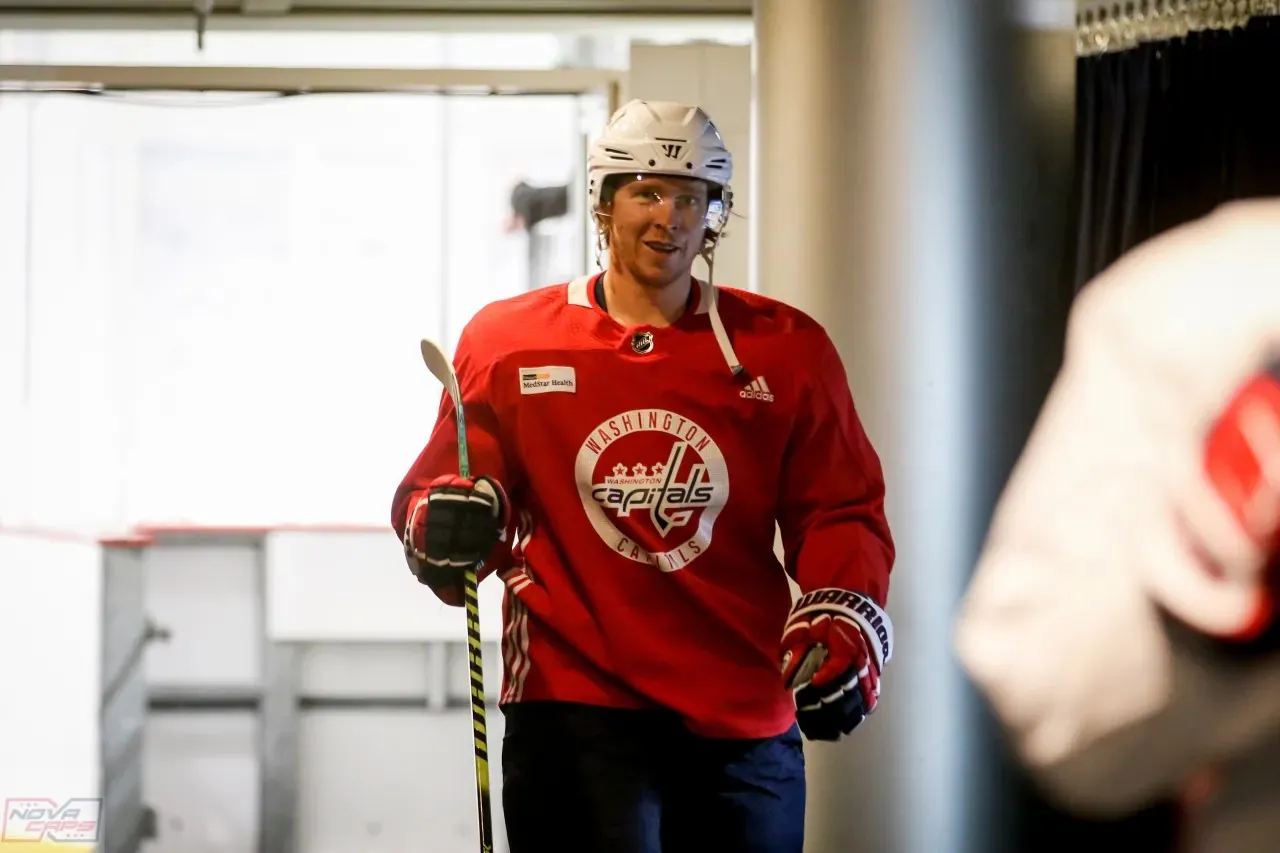
Nicklas Backstrom is likely going to finish his career with the Washington Capitals as the second best player in franchise history behind longtime teammate Alex Ovechkin. However, over the past few seasons, Backstrom has really struggled through a hip injury that has hindered his ability to play without pain.
After last season’s first round playoff exit against the Florida Panthers, Backstrom opted to have hip resurfacing surgery. This was obviously not a light decision, considering there’s only been a handful of NHL players to have this surgery prior to Backstrom, and none of them had much game action after the surgery.
Backstrom has played in 21 games this season, which is a large enough sample size for us to break down his play and evaluate his performance. The statistics used in this post are courtesy of Natural Stat Trick, Evolving Hockey, HockeyViz, and Hockey Reference. If you’d like to learn more about the statistical terms used in this post, please check out our NHL Analytics Glossary.
Five-on-five possession and scoring chance generation
First up, let’s take a look at how Backstrom has performed in the key metrics that help us evaluate on-ice performance:
Overall, Backstrom is hovering around the 50% watermark for nearly all of the key metrics. This means that roughly half of the shot attempts, scoring chances, and high-danger scoring chances are generated by the Caps while Backstrom is on the ice. The downside of this fact is the opposition is also getting roughly the same amount going the other way.
The glaring issue here presents itself in the Caps’ goals for percentage (GF%) when compared to expected goals for percentage (xGF%) while Backstrom is on the ice. The same issue is present when comparing high-danger chance percentage (HDCF%) compared to high-danger goals for percentage (HDGF%) while Backstrom is on the ice.
This is becoming an observable trend for the Caps this season, and here’s a key element of those stark differences between GF% vs xGF%, as well as HDCF% vs HDGF%:
When looking at the Caps’ shooting percentage (S%) when Backstrom is on the ice over his career, you can see this season, the Caps are shooting at a paltry 3.74%. To put this into perspective, the Minnesota Wild have the worst five-on-five shooting percentage in the league this season at 7.02%, with the Seattle Kraken leading the way with 10.33%. The Caps have scored just four goals while Backstrom has been on the ice during five-on-five play with 107 shots on goal. That’s certainly less than ideal.
I mentioned that this stark drop off in GF% vs xGF% has become a glaring trend for the Capitals this season. In another post, I wrote about how the Capitals’ lack of finishing down the lineup has likely been the main driver to the Caps’ lack of success this season. This issue is quite apparent in Backstrom’s five-on-five production, and has had a reasonable impact on his performance this season.
Backstrom has been on the ice for four goals during five-on-five play, and he has assists on all of them. It sure seems like the skill set that’s made him a franchise cornerstone for the past 16 seasons is still there. The issue comes down to a decline in athleticism you see from aging veterans who’ve played over a thousand games in the league.
Another way to evaluate a player’s performance is by observing their Rate Adjusted Plus-Minus (RAPM). This compares a player’s performance against what’s considered a “replacement level” player. Here’s Backstrom’s RAPM chart, courtesy of Evolving Hockey:
One thing stands out above, and it’s that when Backstrom is on the ice, the Caps aren’t generating an excess of goals or high-quality scoring chances, as indicated in GF/60 and xGF/60 (and CF/60 to an extent). What Backstrom does exceed in at this point in his career is limiting the opposition’s quality scoring chances and shot attempts.
Backstrom’s power play performance doesn’t look good, but in the context of the entire team, it makes a bit of sense. Here’s the Caps’ team RAPM chart:
Under special teams, you can see that the Capitals have negative value on the power play as a whole this season. It’s pretty clear that the Caps’ power play has gotten quite a bit stale, especially since they’ve been using effectively the same base power play scheme for nearly a decade. At this point, you have to expect most teams have adjusted to the Caps’ in-zone strategy on the power play.
Overall, Backstrom’s play hasn’t been great this season. To me, that’s kind of to be expected for a 35-year-old center coming off of a surgery that has basically no precedence in the NHL. To that effect, here’s Backstrom’s isolated impact this season, courtesy of HockeyViz:This basically hones in on the points we made above. The Caps aren’t really effective, offensively when Backstrom is on the ice so far this season, but they’ve controlled the pace of play enough where the Caps aren’t awful on both ends of the ice.
At the end of the day, Backstrom’s deployment resulting in -12% performance in xGF/60 and -3% in xGA/60 isn’t where we’d want a player making $9.2M a year to be. The hope is, with smarter deployments and better help offensively next season, the center should hopefully at least make his way back to positive differentials here. The fact is, Backstrom will be 36 next November, and Father Time is undefeated.
Player value using Goals Above Replacement (GAR) and Expected Goals Above Replacement (xGAR)
GAR is a metric that allows us to compare a player’s value production over the course of the season against a replacement level player (which is a player with a value of zero). xGAR is effectively the same, but looks at the expected value the player would bring based on performance.
Let’s dive into Backstrom’s GAR performance this season stacked up against the rest of his career:
The overall downward trend is to be expected for a player late in his career. The issue for Backstrom this season is that he’s dropped into the negatives for the first time in his career for GAR.
Interestingly enough, this season, his GAR is -3.5, but his xGAR is -0.1. The impact of the lack of goal scoring when Backstrom is on the ice is indicative here, as that drives player value in total offensive GAR.
For more pinpointed values in GAR this season, here’s Backstrom’s player card, via Evolving Hockey:
Overall, Backstrom’s even strength offensive GAR (oGAR) is the main driver of his negative GAR value this season. In total, his overall oGAR is driving his value down this season. He’s actually relatively decent defensively, as mentioned earlier, the issue comes down to finishing and offensive chance generation. There’s certainly a question of the talent on the roster currently, which sparked the retool at the trade deadline by General Manager Brian MacLellan. MacLellan needs to find quality linemates for Backstrom that can make up for the weaknesses in his game this late in his career.
Wrapping up
On one hand, this isn’t exactly what the Capitals would want to see from a core piece of this team that makes $9.2M against the salary cap for the next two seasons following this year. On the other hand, it’s hard to expect a ton from a 35-year-old thousand NHL game veteran to immediately bounce back from a surgery with practically no precedence at the NHL level.
Time will really tell if Backstrom can stabilize his performance and get back to being a positive value GAR performer. The skill set is still there for Backstrom, but the issue becomes more of a problem to solve in constructing the roster this off-season. Putting the right pieces around Backstrom is going to be important, as well as managing his deployments and usage. At this point in his career, he’s likely best suited for a third line center and power play specialist role.
‘By Justin Trudel